← All Projects
Artificial Intelligence · Data Science

Rational Medicine Optimization System

A data-driven research project focused on medication waste, prescription planning, healthcare risk analysis and decision support.

Year

2026

Status

Research Project

Role

Data Analysis, Statistical Modelling, Machine Learning

Duration

TÜBİTAK 2209-A Project

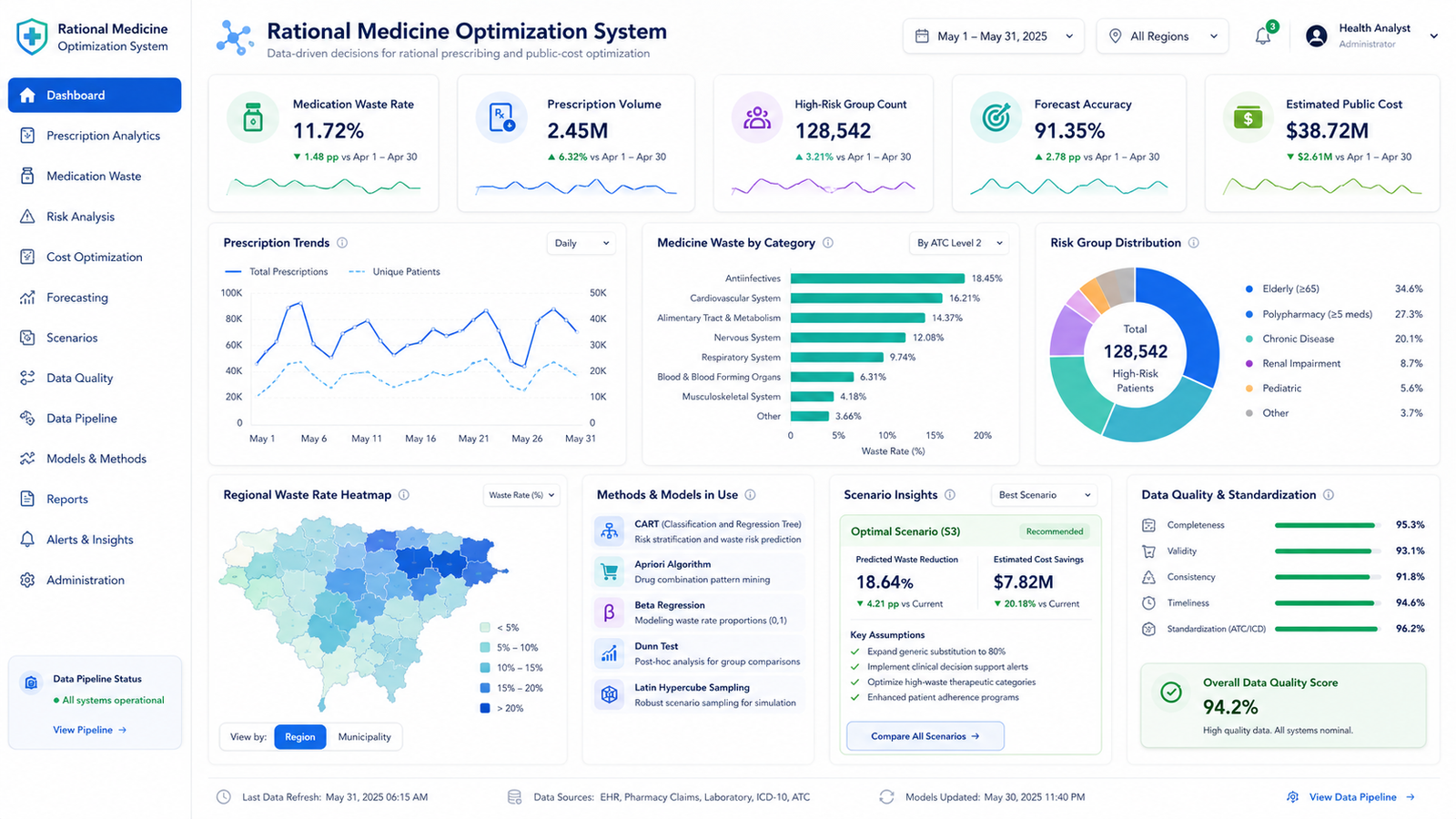
Rational Medicine Optimization System main interface
Project Overview

Context and objective

The project explores how heterogeneous healthcare and municipal data can be transformed into decision-support insights for rational medicine production and prescription planning. It combines data preparation, statistical analysis, machine learning and scenario-based simulation.

The Problem

What needed to change?

Medication waste, limited data availability and inconsistent data sources make it difficult to create reliable planning models. Decision makers need a structured way to analyse risk groups, prescription behaviour, expiration patterns and potential public cost.

The Solution

How the system responds

I developed a reproducible analytics workflow that cleans and standardizes heterogeneous datasets, generates synthetic scenarios with Latin Hypercube Sampling and applies statistical and machine-learning methods to identify patterns and support planning decisions.

Capabilities

Key features

Heterogeneous data cleaning and standardization
Synthetic data generation with Latin Hypercube Sampling
CART-based decision analysis
Apriori association-rule mining
Beta regression modelling
Dunn post-hoc statistical testing
Risk stratification and scenario analysis
Reproducible Docker-based research environment
My Contribution

Role and responsibilities

01

Designing the data preparation pipeline

02

Developing statistical and machine-learning analyses

03

Creating synthetic datasets for data-scarce scenarios

04

Interpreting model outputs and statistical significance

05

Preparing visual analyses and decision-support outputs

06

Containerizing scripts and project dependencies

Technology

Tools used in the project

PythonPandasScikit-learnSciPyDockerGit
Engineering Decisions

Challenges and solutions

Limited and heterogeneous data

The available data comes from different sources and structures. Standardization rules and synthetic scenario generation were used to create a more consistent analytical foundation.

Method selection

Different questions required different methods. Classification, association analysis, regression and non-parametric testing were combined instead of forcing every problem into one model.

Outcome

Results and impact

Created a structured pipeline for analysing medicine-related datasets
Supported scenario testing under limited-data conditions
Combined statistical and machine-learning methods in one workflow
Produced decision-support outputs focused on waste, risk and public cost
Project Gallery

Selected screens and system views

Rational Medicine Optimization System project screen 1
Rational Medicine Optimization System project screen 2
Rational Medicine Optimization System project screen 3
Related Services

Need a similar solution?

Continue Exploring

Related projects

Have a similar project in mind?

Let’s discuss the workflow, technical requirements and product direction behind your idea.

Discuss Your Project

© 2026 Doğukan Kıralı. All rights reserved.